
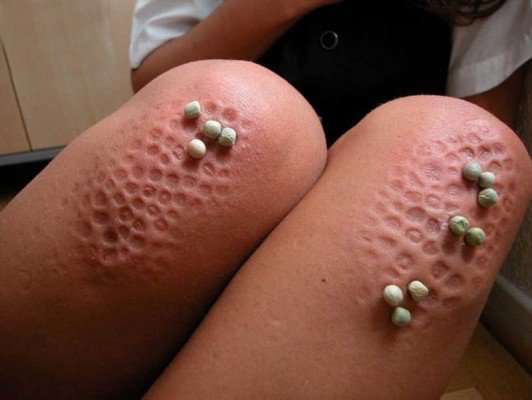
Children had to kneel on dry peas.
This was especially practiced in the times around the world wars to break the will of the children, here in Germany.
Torturers would be jealous if they knew what teachers came up with.
But what you see above is a real photo. A girl who recently had this done to her at school posted the picture.
What you see in the picture are her knees. Not her fingers, as it might seem.
Today, this school punishment is still common in parts of China and the Philippines.
Paws
These are blows on the outstretched hand.
It was banned completely only in 1980!
One hit with willow or hazelnut sticks on the palm or the fingers. Blows to the fingertips were considered particularly unpleasant and painful.
Patting was considered an alternative to caning on the buttocks, which was otherwise used as a punishment, and was often carried out on girls.
Depending on what a student had “done wrong,” two to five strokes were administered. But a teacher had no prescribed limit.
Thus, after this ordeal, students often had swollen hands and could not even write properly.
Therefore, the paws were given on the left hand. Children were only allowed to write with their right hand anyway.
Often they had to stand in the corner afterwards.
I even remember standing in the corner. However, it has not happened to me, but I have seen it.
When the paw stick was dry or worn out, a new one had to be found, and the children often had to go and look for it themselves in nature.
A special pedagogical effect was seen in the fact that the child had to make the beating possible by “voluntarily” presenting his hand.
The willful suppression of an innate protective reflex necessary for this was supposed to strengthen willpower and self-discipline.
If a child withdrew his hand in fear, he received a harsher punishment.
These are only small examples.
And the bad thing is that most of us who are no longer very young grew up with these teachers. The kind who beat the children before it was forbidden.