
The one case I can think of when surviving Roman legionaries came back to total disgrace was after the Battle of Cannae.
In this battle, 80,000 Roman soldiers fought against 50,000 Carthaginians. Out of this total, only a few thousand Romans made it back to Rome after the brutal defeat that the Carthaginian general Hannibal inflicted. It was the worst defeat Rome had ever suffered and would ever suffer throughout all of its history. The situation was so bad that in the aftermath of the battle, Rome did not have enough soldiers to field any legions, leaving Italy entirely at the mercy of Hannibal’s Carthaginian army.
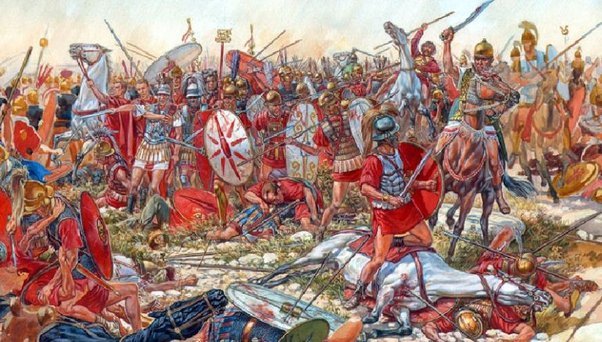
Artist’s impression of the Battle of Cannae, which remains a contender for the deadliest day of battle in Western history.
The legionaries who came back from Cannae were so disgraced that they were not allowed to serve in any of the new armies raised in the following years. While Roman armies secured Italy and pushed across the Alps for the first time to conquer Carthaginian holdings in Hispania, the survivors of Cannae remained dispersed on the island of Sicily for the remainder of the war with Carthage.
Why Rome did this is clear: they had an obscene amount of pride, and living reminders of devastating defeat within the ranks of their armies were not what they wanted. Rome stood obstinately in the face of incredible losses: at a point when pretty much any other state would have capitulated, its leaders continued to make patriotic speeches and the people kept their spirits high. The sacrament of honor was one of the most important tenets of Roman society. The soldiers who had died had died honorably; those who did not came home in shame.
In any case, these soldiers got their redemption. Years later, the rising star Scipio Africanus (who was himself a survivor of Cannae, managing to break through the Carthaginian encirclement) swept through Sicily with a small army of volunteers, seeking to expand his franchise and launch a final attack on Carthage itself. Flocking to his banner were those same veterans of Cannae, older and wiser and eager to prove themselves. Prove themselves they did; at the Battle of Zama in 202 BCE, with the help of the survivors of Cannae, the Romans dealt the decisive blow to Hannibal’s defending army, forcing Carthage to surrender after almost two decades of war.
In other cases when Roman soldiers came back from defeats, the treatment was not nearly as harsh. For example, when Tiberius Gracchus secured the release of a trapped Roman army in Hispania, the soldiers that came back were welcomed by society and most of all by their grateful families. The same applied to soldiers who were forced to pass under the yoke by the Samnites during the Samnite War, a great humiliation that nonetheless did not significantly affect the reputations of the survivors. The situation of Cannae was so uniquely humiliating that treatment went to an extreme.
Most soldiers survived defeats that did not result in existential threats to Rome, and they simply went right back to serving.