
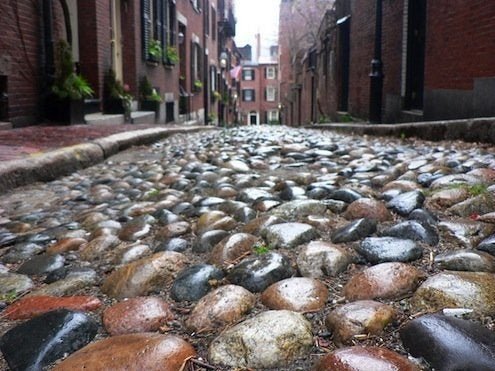
Throughout the 1500–1700s, ships sailing from Europe to what is now the east coast of the United States would use stones as ballast in their holds when coming from Europe, then ditch the stones to make room for cargo (like lumber) heading back to Europe. There wasn’t much of a market for European goods coming to the colonies then, so it made more sense for ships to just carry worthless stones while leaving Europe, so they could just ditch them once they got here. Those tossed-overboard ballast stones became a huge problem in some ports, so different ports passed different rules against ships tossing those stones overboard. They also found uses for the stones which had already been tossed over, including this:
There’s a chance, if you’re in a port city on the east cost of the U.S., and you’re on a cobblestone street, those stones didn’t come from some local river or quarry, but, in fact, came from Europe, as ballast on a sailing ship, some 300+ years ago.
Growing up, my godfather lived in a log cabin in the middle of several dozen acres of forest on the N.C. coast. Once, while hiking a backwoods trail with him, he showed me a very old stone that looked out of place in the middle of the woods. He told me that it was a ballast stone from a ship from the 1500s, and it had been placed there as a grave marker for an explorer who died while exploring the area back then. My godfather has since died, but my godmother still lives in that log cabin. The next time I visit her, I’m going to see if I can find that stone again and take a picture. It wouldn’t surprise me at all if there really was an early European explorer buried underneath it. It’s just close enough to the coast to be probable.