
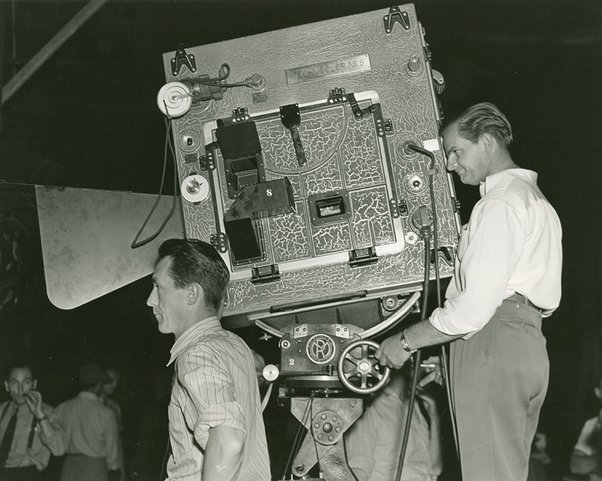
Technicolor was a very expensive process and the technology imposed a lot of limitations. To start with, here’s the camera.
It’s so big because it’s shooting three movies at once. A prism in the front splits the light into three beams. Each beam goes through a color filter.
Since the beam of light was split into three, it required very bright sets which is part of what gave it the bright colors.
The size of the camera makes it difficult to use. You can’t move it easily and shots like a close-up from below might require the actor to be elevated. Possibly by strapping boxes to his feet.
(From a Monty Python sketch. They didn’t really do this).
Because it shoots three strips of film at a time, Technicolor triples the cost of film. Then it has to be developed. That was a complicated process where the film was developed as a negative. Then colored dyes added to the film using a process where the more light went through the film the more dye was fused to it. That gave three colored strips.
Then they were fused together to make the finished film reel.
There were advantages to Technicolor. Color adjustment was possible during processing. In fact, they always had to do adjust it. When they filmed a good take they would also film a color reference wheel known as the Peacock. That let the technicians make sure that the colors on the screen matched what was filmed.
(I heard an interview with one of the Munchkins. He said that when they had a good take they’d announce “That’s a peacock” and bring out the reference wheel.)
All of that processing added a huge expense to a movie.
That expense and lack of flexibility meant that Technicolor was phased out. The last two movies filmed in Technicolor were The Godfather and The Godfather Part II. And that was before the advent of digital cameras.
These days the lens is the biggest part of a movie camera. The camera itself is small. It also has a screen for playback so that the director can review the footage immediately.
Digital also lets a director change the saturation, lighting, etc. in post-production much easier than with film. And, in the days of digital effects, even movies shot on film are digitized so that the effects can be added.