
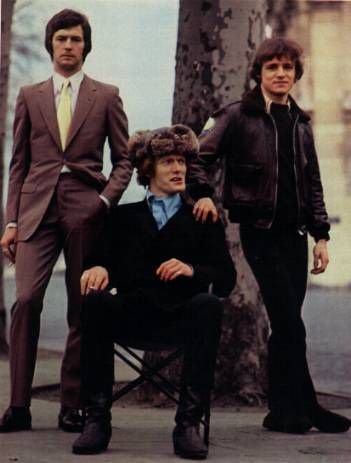
Because it had only three members, and two of them loathed each other.
Here are the boys in 1966, before the acid’s kicked in, and 21-year-old Eric Clapton (left) already has the tight-lipped expression of a man who’s had to spend too many hours in the pub listening to one of his other bandmates bitching about the third one.
The exact nature of the beef between Ginger Baker and Jack Bruce may never be known, but it dated back to when they played together in the Graham Bond Organisation. Apparently it extended to sabotaging of each other’s equipment, which is, shall we say, uncharacteristic in professional musicians. When Bruce got fired, he continued to show up for gigs until Baker warned him not to at knifepoint.
Anyway, Baker got sick of working for the notoriously unreliable Bond, and was thinking of quitting. He drove to see Clapton play with John Mayall and afterwards, offered Clapton a lift back to London in his Rover. Clapton was impressed with Baker, his car and his driving, and when Baker said that he was thinking of starting a band, Clapton said that so was he. Baker invited Clapton to join his, and Clapton agreed, but on condition that Jack Bruce play bass.
Baker was so surprised that he almost crashed the car. Nevertheless, for perhaps the last time in his life he reined himself in and decided that it could be worth it.
Baker and Bruce were good enough musicians to realise that the music the three of them made together was worth sticking together for, but the band quickly got locked into a punishing touring schedule.
They played their first gig on 29 July 1966, but according to Search for setlists: artist:(Cream) date:[1966-01-01 TO 1966-12-31], in the rest of that year alone they played 105 gigs, a schedule of truly Beatlesque heroism.
In 1967, it was 186 gigs and unlike the previous year, this time it was all over the world. (Search for setlists: artist:(Cream) date:[1967-01-01 TO 1967-12-31] (page 15))
In late March ’67 alone they had a residency at the RKO 58th Street Theatre in which they were playing two or three shows a day, for days on end.
And Cream shows were not simply a matter of bashing out the hits. The band brought extended improvisation to mainstream rock music in a way that few other bands had done. They had to go on night after night and jam, and it had to be amazing.
Under the circumstances, it’s not surprising that they quite often weren’t amazing. The tension must have been extreme. In addition, there was the tendency for gigs to get louder and louder and louder. Bruce credited those years on the road as doing permanent damage to his hearing, not that they were really listening to each other anyway: Clapton once remarked that he’d stopped playing completely during a Cream concert, once, and neither Baker nor Bruce had even noticed.
Baker and Bruce fought, and Clapton, the youngest member, had to mediate, and not being especially mature himself, he wasn’t very good at it.
They decided in 1968 to break up, and still managed to play 114 gigs that year (Search for setlists: artist:(Cream) date:[1968-01-01 TO 1968-12-31]).
They all felt that the band’s performances were deteriorating. I was a devoted Cream fan as a teenager in the 80s, but even I couldn’t bring myself to listen to most of their interminable live recordings more than once. There’s only so much pentatonic noodling a boy can endure. (Well, without drugs, anyway.)
Clapton went on to record his masterwork, Layla and other Assorted Love Songs, and then coasted gently for the rest of his career, only kicking himself up the arse for the memorial concert for his friend George Harrison.
Bruce made some fascinating music with interesting people. Baker too; I get tired of the endless praise handed to John Bonham and Keith Moon when Baker was at least as distinctive as either of them, and certainly a better drummer, technically, than Moon. (There’s no freaking way that Moon would have been capable of something as ferociously minimalist, brilliant and responsive as Baker’s brushwork on ‘Traintime’, from Wheels of Fire. Edit: If you’re reading this and you’re oh so outraged that I suggested that Keith Moon isn’t the greatest drummer of all time, and you want to post an angry comment, don’t bother.)
To sum up: Cream only lasted two years because, having personnel problems from the start in the form of the intense antipathy between two of its members, it found itself in a pressure-cooker situation where it had to be endlessly creative, all the time. The musical task it set itself was to improvise a lot, but the playing schedule was more suited to a band that only had to perform pre-written material.
In those conditions, it shouldn’t be surprising that it didn’t last very long.