
.
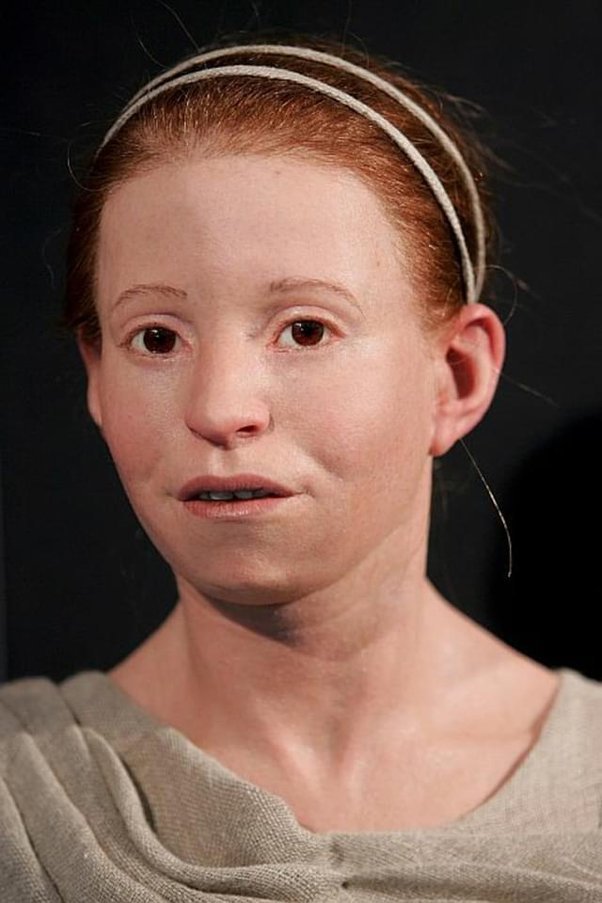
Her hair is red. Her eyes are brown. Her teeth are slightly flushed. Her nose is straight. Nothing in her face testifies that she lived and died about 2,500 years agο.
In 1994-1995, during the works for the construction of the new underground railway of Athens, the area where it was known that the cemetery of ancient Athens existed was found in the area of Kerameikos. The archaeological excavation brought to light a mass grave with skeletal material from the burial of about 150 people, adults and children. Τhese people died from typhoid fever during the plague which hit Athens between 430 and 426 BC. whose victim was also the great Athenian general Pericles. Among the bones of the mass grave was the skull of a girl about 11 years old, who was given the name Myrtis.
The fact that the skull was intact, only the nasal bone was missing, it had all 28 teeth, and -something quite rare according to the experts- they were present together with the permanent and new teeth, made possible the research and the regeneration of her face. The inspirer of the “revival” of Myrtida and the soul of the interdisciplinary project, is the professor of orthodontics at the University of Athens Manolis Papagrigorakis, in collaboration with a team of scientists of various specialties.
For this purpose an exact copy of the skull was made – with the most modern scientific methods – and sent to a special laboratory in Sweden. So began the study of skeletal material with modern laboratory DNA methods, in order to determine the causative agent of the deadly disease. To investigate the pathogen responsible, the medical-dental team used the pulp of three intact teeth, from three randomly selected skulls, where traces of the microbial agent were detected. Scientists have identified the bacterium Salmonella Enterica Serovar Typhi.