
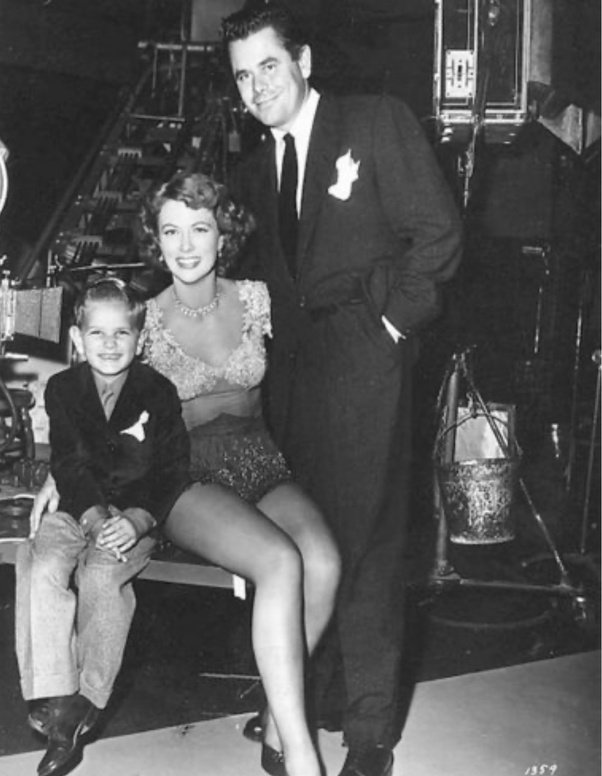
In a photograph taken in 1950, Eleanor Powell and Glenn Ford appear like the picture of Hollywood happiness—two glamorous stars standing proudly with their young son, Peter. To the outside world, they looked like the perfect movie-family dream. But behind that polished image was a far more complicated story of sacrifice, love, talent, and heartbreak.
Eleanor Powell was not just a movie star—she was a phenomenon. A legendary dancer during Hollywood’s Golden Age, she starred in a string of hugely successful MGM musicals at a time when the studio desperately needed box-office hits. Her films were so profitable that many insiders later said she helped keep MGM from financial collapse. Fred Astaire himself once told her son Peter that Eleanor was the greatest dancer ever captured on film—praise that, coming from Astaire, meant everything.
Beyond her talent, Eleanor was known for her strong sense of fairness and integrity. One of her closest friends was the iconic tap dancer Bill “Bojangles” Robinson. During an era of deep racial segregation, it was common for Eleanor to be allowed through the front entrance of studios and theaters while Robinson was forced to use the back door. Eleanor refused to accept this quietly. Whenever Bill was sent to the back, she went with him—choosing solidarity over privilege, even when it cost her socially.
In 1943, at the height of her fame, Eleanor married Glenn Ford, a rising leading man known for his charm and screen presence. When their son Peter was born, Eleanor made a life-altering decision: she stepped away from her wildly successful career to become a full-time mother. Her goal was simple and deeply personal—to give Peter a calm, loving, and stable home, something she felt Hollywood could never offer.
Glenn Ford, however, struggled to live up to that same vision of family life. Charismatic and handsome, he developed a reputation for having numerous affairs, including a well-known relationship with actress Rita Hayworth. Years later, Peter would speak honestly about his father, writing, “He was a bad boy. He got involved with a lot of the ladies he worked with. That’s not anything that I’m proud of, but that’s the reality.”
The marriage eventually collapsed under the weight of these betrayals, and Eleanor and Glenn divorced in 1959. Glenn went on to marry three more times, continuing his turbulent personal life. Eleanor, in contrast, never remarried. She devoted herself to raising Peter and living a quieter life away from the spotlight she once ruled.
What remains today is not just the image of a glamorous Hollywood couple, but the story of a woman who gave up fame for family, stood firmly for equality, and chose dignity over bitterness. Behind that smiling 1950 photograph is a powerful reminder that even the brightest stars often carry hidden shadows—and that true strength doesn’t always stay center stage.