
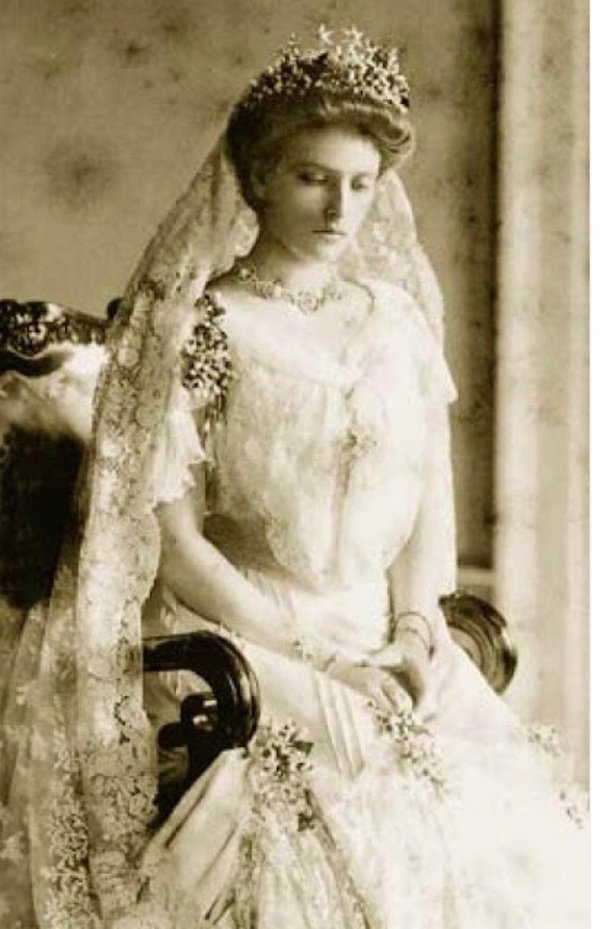
Prince Philip’s mother, Princess Alice, was congenitally deaf and known to be so. This was a disability that affected her whole life, but it turned out to be an advantage at a perilous moment during World War Two. When the Nazis questioned her about rumors that there were Jews staying with her in Athens, she convincingly pretended not to understand them. She cleverly hid them for a year, saving the lives of the Cohen family and herself. Had she been caught defying the Nazis she probably would have been made an example. Others in Greece were. Her actions took courage (the Nazi military headquarters were within throwing distance), which is something this woman, a great granddaughter of Queen Victoria, had in abundance.
Sheltering the Cohen family is one of many good works that Princess Alice of Battenberg—also known as Princess Andrew of Greece upon her marriage—completed in her lifetime. Her overcoming deafness and learning how to read lips fluently in four languages seems almost a footnote in her biography because of the charitable life she led.
While in exile in Paris and separated from her husband Prince Andrew of Greece and Denmark—who was arrested after the Greek monarchy was overthrown—she worked to help settle Greek refugees. However, in this period she started to have problems. She had a nervous breakdown that saw her sent to a psych hospital for having religious visions. She endured primitive psychiatric treatments that were considered helpful in the early 20th century (forced hysterectomy) but which are now frowned upon as useless if not barbaric.
Things did not get simpler for Alice. Her husband Andrew took up a playboy lifestyle, often sponging off wealthy relatives in Paris. The entire Greek royal family was relatively penniless. He eventually settled in with a mistress. Alice and Andrew’s youngest child Philip, the future husband of Queen Elizabeth II, became a bit of an orphan. He was luckily taken in by Alice’s brother in Great Britain, Lord Mountbatten, who raised him to be a British gentleman.
Alice’s life was not defeated by her illness nor the semi-barbaric treatments she was given according to the scientific theories of the time. She returned to Greece, and though she never formally took vows, she formed a Christian Orthodox order of nuns that cared for war refugees and the poor. She continued this work until another coup in Greece occurred in the late 1960s, making it unsafe for her to operate her religious order. She moved to London where she lived out the rest of her years as a guest of Queen Elizabeth II.
Some might not know that in addition to being almost heroic in her charitable work in Greece, Princess Alice was in her prime a stunningly beautiful and well-liked princess. This might not be surprising given how handsome her youngest child, the fair-haired Prince Philip, was in his heyday.
Alice overcame wars, coups, her royal relatives being assassinated, her husband being imprisoned by anti-monarchists, her husband’s philandering, and the Greek royal family being almost penniless and stateless. She overcame mental illness, and she made her life about helping the unfortunate and living simply.