
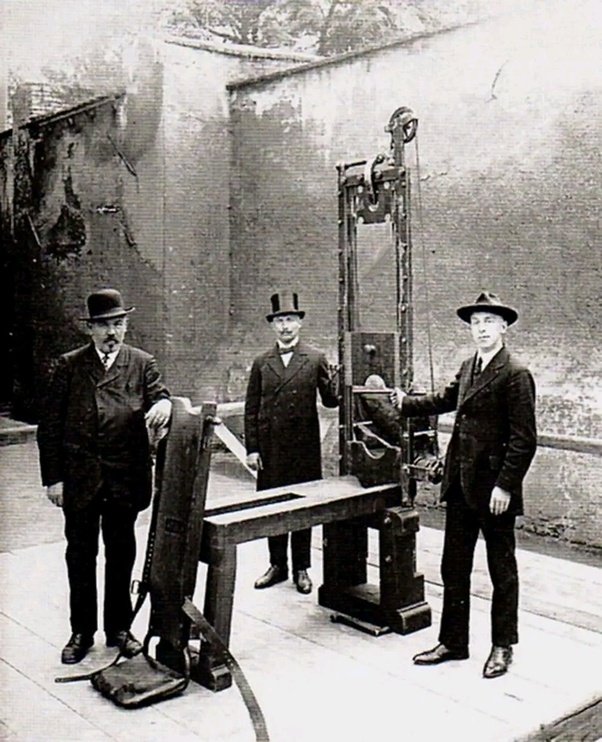
Johann Reichart was paid 3,000 marks a year for beheading people and received a bonus of 65 marks for every head detached. It was such a high salary that, after a few years of working in the service of the Third Reich, he was able to buy a villa in a wealthy area of Munich.
At the beginning of his chancellorship, even Adolf Hitler was opposed to the death penalty. Not for ideological reasons, but for practical reasons: he feared that putting German citizens to death would alienate his sympathies. His resolve, however, was short-lived. It is estimated that in the 12 years of the Nazi regime around 16,500 people were beheaded. The guillotine could conjure up images like those of the French Revolution, placed on a stage in the middle of crowded squares. In reality, the Nazi guillotine, like everything else about the Nazis, had a pretentiously professional and “clinical” air. It was placed in a clean, well-lit room, like an operating room, and operated on by men in smart suits. It was like walking into a dentist’s office.
Also, the Nazi guillotine had improvements. As can be seen in the photo below, a folding table was added for tying the condemned, in order to facilitate the positioning and subsequent removal of the decapitated body.
The youngest man sentenced to death by guillotine was 17-year-old Helmuth Hubener, accused of distributing anti-war leaflets in Hamburg. Even some members of the Gestapo asked for clemency for the minor, who, however, showed considerable courage. He told the judges: “Now I will have to die, even if I didn’t commit any crime. Now it’s my turn, but yours will come”. Despite courage and despite Gestapo demands, Helmuth was beheaded at 8:13 pm on 27 October 1942.
Another victim of the Nazi guillotine was the much more famous Sophie Scholl, one of the leaders of the White Rose, the pacifist group that distributed anti-Nazi leaflets. Sophie was the first of her companions to be sentenced to death. Her execution, via the guillotine, took place just 3 hours after the sentence was pronounced. According to one witness, going to the guillotine showed considerable courage, and Reichart himself, responsible for her execution, will later declare that Sophie was the bravest of all her victims.
The guillotine is now kept in the Bavarian National Museum.
Posted by RI Shohag