
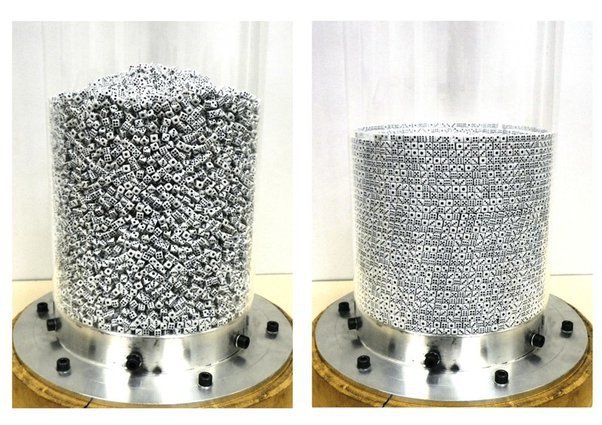
A group of Spanish and Mexican researchers loaded 25,000 6-sided dice, each about half a centimeter side, into a transparent cylinder.
They then applied different agitation effects to the cylinder to see which one could cause the most effective compaction.
At first, they began to shake the container, turning it alternately controversially, clockwise, and then counterclockwise about once every second.
This alternate rotation method worked best, but only when the rotation was fast enough.
The rotation exerted a force on the nuts directed towards the walls of the container. At the same time, the periodic shocks when the direction of rotation was reversed caused an oscillation of the mass of nuts.
By adjusting the speed of the rotation, the researchers were able to vary the strength of these jolts. With an acceleration of 0.52 g, the nuts end up in horizontal layers inside the cylinder in a concentric ring pattern after 10,000 alternating rotations. At lower speeds, however, rotation can take years to achieve ideal compaction.
The researchers hope their method is a possible new means to compact materials as part of manufacturing processes or even to pack granular materials.
In fact, this method appears to be much more efficient than tapping. In fact, a granular system, if tapped, does not reach a state of maximum density by itself, but tends to remain stuck in a state of intermediate density.
So here is the (literally) most “counter-verse” experiment in history.