
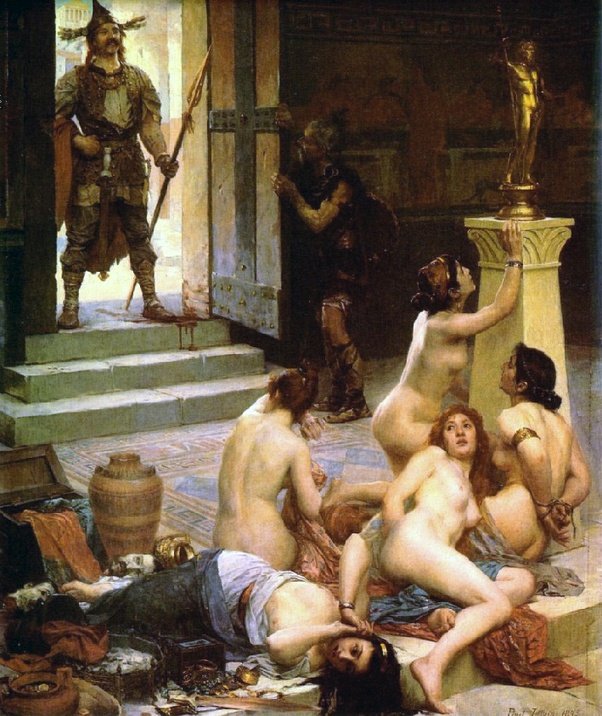
To me at least, it’s the sack by Brennus in 390 BCE.
The reason why I say this is because of its extremely pivotal timing. When Brennus’s Gauls sacked the Eternal City, Rome was not yet a dominant imperial power. The Republic wasn’t even a respectable regional force; it was just another power among many in Italy. There was barely anything special about Rome at that moment, nothing that might indicate or foreshadow its future hegemony over the Mediterranean.
Brennus’s sack changed all of that.
Rome was totally and utterly defeated by the Gallic invasion. Brennus’s Gauls broke through the outer walls and pinned the Romans up on one of the hills, while they burned the rest of the city. In the end, an agreement was finally made under which Rome would pay a massive indemnity in precious metals in exchange for Gallic withdrawal. When the Romans brought the agreed-upon amount to the handover ceremony, Brennus abruptly changed his terms by throwing his sword upon the scales. The Romans protested, but Brennus simply said, “Woe to the vanquished.”
The Gauls were gone, but so was nearly all of the former Roman capital, as well as much of its movable wealth. The surviving inhabitants were immensely demoralized, coming off of the hill to see heaping piles of rubble and bloody bodies where their homes had once stood. Reportedly, there was serious talk of pulling an Alba Longa and abandoning the site, going off to live in Veii.
At this darkest of moments, the Romans showed the trait that would make them masters of the world. They chose to stay.
Hungry, poor, and destitute, just as they had been in the founding days of the city, the residents rebuilt city blocks one by one. Patricians and plebeians worked side by side, all divisions forgotten. There were no surviving urban plans, so most of the city was constructed in a ramshackle, disorganized way. Almost all other Roman cities were founded upon orderly streets and blocks, but the Eternal City is a jumbled mess of alleyways and city blocks strewn about like dropped Jenga blocks.
Even today, one must ask “what is this”
Rome would come under near-constant assault in its state of weakness over the following decades, but in each conflict, the Romans would defend their new city with unmatched fervor. They would then take the fight to their enemies, growing in strength with each victory. Just over a century later, Rome controlled the entire peninsula of Italy.
This determination first displayed in the ruined streets of a burning city would forge an empire across three continents.