
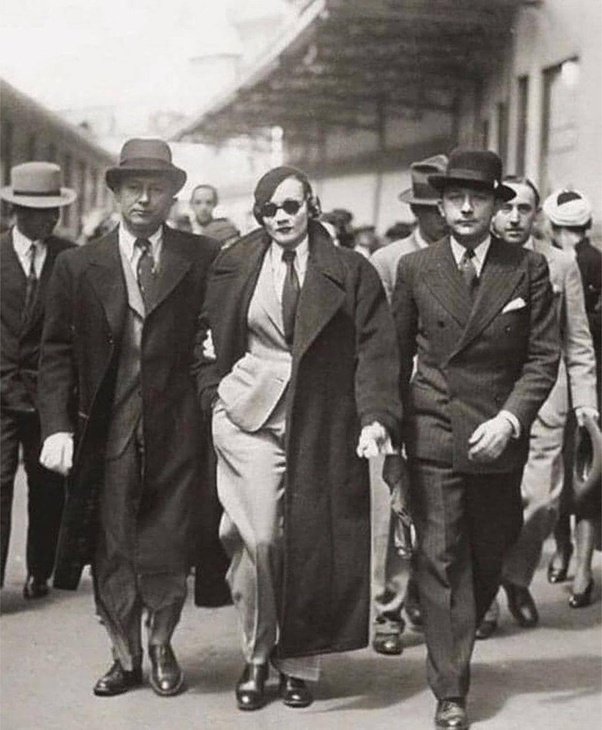
In 1933, Hollywood star Marlene Dietrich turned a simple outfit into an international statement about freedom and fashion.
At the time, France still had an old and unusual law dating back to November 17, 1800, which technically required women to ask police permission if they wanted to “dress like men” — especially by wearing trousers. Although the rule was rarely enforced by the 20th century, it had never been officially removed. By the early 1900s, women were allowed to wear pants only in special situations, such as riding a bicycle or a horse.
The Journey to Paris
In 1933, Dietrich was traveling from the United States to France aboard the famous ocean liner SS Europa. During the voyage, she wore a striking white pantsuit, something bold and unconventional for a woman at that time.
When news reached Paris that Dietrich planned to arrive wearing trousers, the Paris police chief reportedly warned that she could be arrested if she stepped into the city dressed that way. The warning was based on the old 1800 law.
But Marlene Dietrich was not someone who gave in to pressure.
Her Bold Arrival
After docking in Cherbourg, Dietrich continued her journey to Paris. She wore:
- A tailored tweed suit
- A tie
- A man’s overcoat
- Sunglasses
When her train pulled into Gare Saint-Lazare station in Paris, photographers and journalists were waiting. In a now-famous moment, she stepped off the train calmly and confidently — reportedly with a policeman lightly holding her arm.
Despite the earlier threat, she was not arrested.
The image of Dietrich walking through the station in her tailored suit became iconic. It symbolized not just fashion rebellion, but also a challenge to outdated gender rules.
Why It Mattered
Marlene Dietrich was already known for playing with gender style — wearing tuxedos, suits, and traditionally masculine clothing both on screen and in real life. Her Paris arrival strengthened her reputation as:
- A fashion pioneer
- A symbol of female independence
- A challenger of restrictive social norms
Although the law was rarely enforced by the 1900s, it technically remained on the books for more than 200 years. It was finally officially repealed on January 31, 2013, by French Minister for Women’s Rights Najat Vallaud-Belkacem, who declared it incompatible with modern equality principles.
The Legacy
Dietrich’s 1933 arrival in Paris is remembered not because she was arrested — but because she wasn’t.
Her calm defiance showed that sometimes simply walking forward with confidence can challenge even centuries-old rules.