
In 1979, a happy family went to Buffalo Cave in Idaho to look for old arrowheads made of stone. Instead, they found a mummified human torso inside a jute sack.
Because the body was well preserved, thanks to the cave’s environment, the coroner first thought the person had been dead for between 6 months and 5 years.
In 1991, a girl found a human hand at the same place. Later, two legs and an arm were also discovered.
The remains stayed unidentified for 40 years. Then, in 2019, scientists used DNA from the bone marrow in the leg and found a match in a database. The results were surprising and changed the earlier ideas about when the person died. The victim was the grandfather of an 87-year-old man from Salt Lake City.
More research showed the man was Joseph Henry Loveless, a famous criminal who disappeared in May 1916 after escaping from prison. He was there waiting for trial because he was accused of killing his wife with an axe.
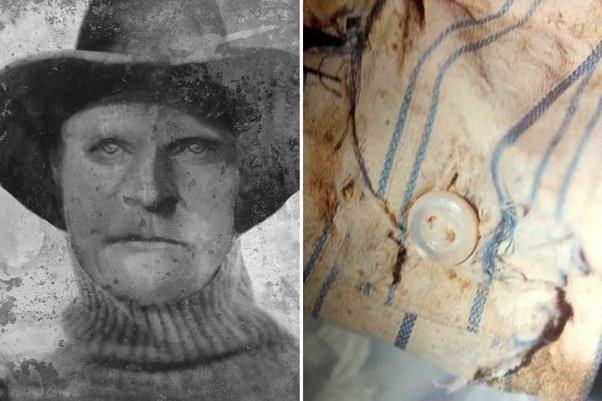
He was still wearing the same clothes from the day he escaped, which were described on wanted posters. This shows he was probably killed soon after escaping.
This case is likely the oldest murder victim identified in American history—103 years after the crime.
The case is still open because no one knows who killed him, but some think it might have been his wife’s family taking revenge.
On the left is a drawing of what Loveless may have looked like, and on the right is a picture of his shirt.