
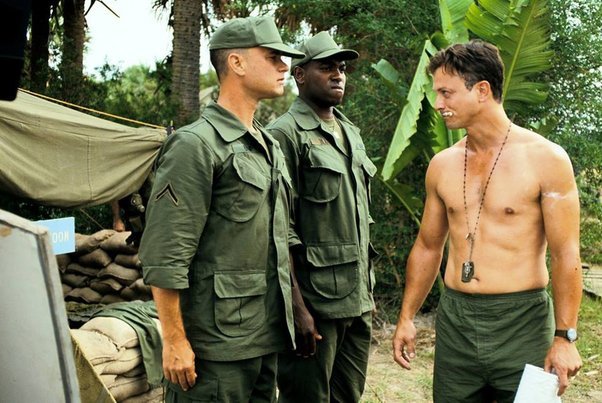
It actually happened in real life. The real life Forrest Gumps did not do well. Like, not at all.
As the Vietnam War heated up, the insatiable demand for American troops put the administration in a bind. Where to get bodies, and not risk a public backlash? As the draft was set up at the time, college students got deferments. You could get enough bodies if you end student deferments, but college students were predominately the kids of the middle and upper classes. The people whose opinion counted the most with Congress and the media. Lose their support, and American involvement in Vietnam could not continue.
Their support or acquiescence would end if their kids’ student deferments were cancelled, and they were drafted and sent to fight and die in Vietnam.
You could mobilize reservists to furnish enough bodies, but same problem: the reserves and National Guard were overwhelmingly filled with the children of the well off and connected. Think George W. Bush and how he spent the Vietnam War years in the Air National Guard. Sending such privileged youths to Vietnam would produce a fierce backlash.
So the Pentagon came up with a shameful brainchild: Project 100,000. It was painted as a Great Society program. It would take impoverished and disadvantaged youth, and break the cycle of poverty by teaching them valuable skills in the military.
In reality, Project 100,000 simply amounted to lowering or abandoning minimal military recruitment standards to sign up kids who had been rejected by the draft as mentally or physically unfit. Recruiters swept through Southern backwaters and urban ghettos, to sign up almost anybody with a pulse. That included at least one recruit with an IQ of 62. They disproportionately focused on black kids. 41% of Project 100,000’s recruits were black, compared to 12% in the US military as a whole. In all, 354,000 were recruited.
Needless to say, they received no special training or skills. Once they signed on the dotted line, “the Moron Corps”, as other soldiers called them, were rushed through training, then bundled off to Vietnam. Once in country, they were sent into combat in disproportionate numbers.
In combat, their mental and physical limitations – the reason they were rejected by the draft in the first place – ensured that they were killed and wounded in disproportionate numbers.