
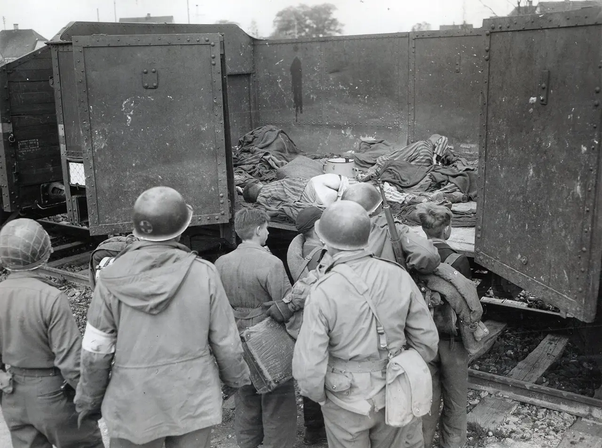
When American G.I.s entered the camps like Dachau (no celebration), it was a shock to their systems. While they had experienced combat, many could never have fathomed the “Death Train,” where boxcars were piled on top of one another full of frozen and starving skeletons. They had nothing in their experiences to prepare them for what they saw.
First, there was shock; then anger; finally, they understood that justice now had its own set of rules. The first victims were not even human. The guards’ dogs, who had been trained to instill fear in prisoners, were killed without remorse. The G.I.s acted without hesitation. They had lost their respect for protocol.
Military protocol says that prisoners be taken when captured, but in the coal yard and the so-called hospital, the S.S. guards had lined up to face the American soldiers. Instead of seeing soldiers, the American soldiers saw walking poison. Guns fired, and bodies dropped. Coldly, quickly, without emotion.
And then there was silence. Surviving prisoners, mere shadows of what they used to be, turned on their oppressors. Shovels, hands, fists; some G.I.s were only observers and let the men use their weapons for revenge; others handed over their weapons without a word. To them, they were ensuring that the scales of justice were balanced.
The camps were not only a result of war, but also an example of how unchecked evil manifests itself. To the men who liberated the camps, this was the most disturbing experience ever.